Property, Mindset & Personal Development, Protecting Your Wealth
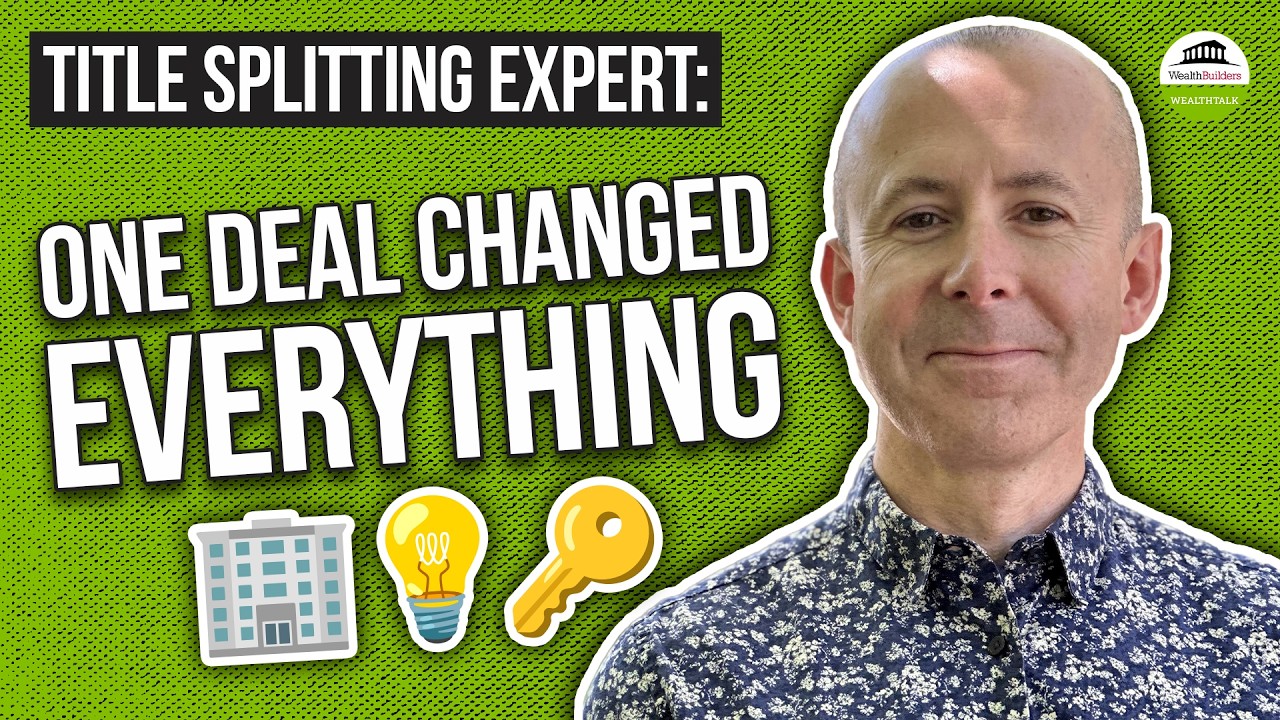
How One Deal Made James Lynch Financially Independent
Transcript
speaker-0 (00:00.078)
One particularly big property that we bought in 2022 going into 2023 using the title split methodology, a 1.4 million purchase, which would have been completely out of our grasp, became something that we were capable of buying. And in doing that, basically bought enough income to stop working.
speaker-1 (00:23.512)
Hello, hello, and welcome to another episode of Wealth Talk, the powerful way that you can learn how to build, protect, and transfer your wealth. And we're going to be talking about all of those things with our guest today, James, who's going to be sharing really his journey, a touch on how he's completely transformed his life from moving from being dependent on a job to being, you know, financially independent of that.
so James, say hello and introduce yourself.
speaker-0 (00:54.862)
Hi everyone, yeah so I'm James Lynch. Some of you may already know me as the title split consultant. That's sort of the area I work in and yeah thank you for having me today Kevin.
speaker-1 (01:05.4)
It's always nice to wear a badge, you know. I I was introduced recently on a presentation I did and they called me Mr. Sass. Well, you know, I didn't ask for the title, but but I'll take it. James, we go back a long way, right? Because as far as twenty two, I think. So what was happening to you in twenty two and what was the the catalyst that made you think, hmm, trading time for money, perhaps not the best idea in the world?
speaker-0 (01:34.126)
I'd been a project manager most of my career, mechanical engineer trained and then project manager and a mix of contract jobs and perm jobs. But it's a little bit of a cliche, but thinking during the COVID period that, you know, perhaps we could do something a bit different. And that led us in 2022. There was a couple of things going on around that time. So we decided that
with our existing property business and our existing pensions, there was a route there into SAS and obviously yourself and wealth builders gave us the route to do that. And then we also sort of decided, we being myself and my partner Laura, we decided that it was time to take a bigger step in property and
have that income grow so that we could rely on it and not have to trade time for money. So basically some research followed and some learning and that led us into the idea of title splitting and basically one particularly big property that we bought in 2022 going into 2023, which enabled us to step back from work and to focus on property full time.
speaker-1 (02:48.43)
So one project enabled you to do that.
speaker-0 (02:50.606)
One project, yeah. we did, mean, in fairness, we already had say, I think about five properties in the background, single let, you know, they weren't really sort of set in the world of light with their income, but it was a little bit of a starting point, which was obviously good. And then, yeah, one property, it was a block of 40 flats, but still one property that using the title split methodology, we were able to
find this block, it was 1.4 million which you know 35,000 pound a flat. It was in West Wales where property is a lot cheaper but property is not that cheap in West Wales. So I could see there was the uplift potential there and what we were able to do is we were able to have that valued at its true individual leasehold value, so you know the breakup value and then get lending arranged at a
loan to value against that higher value, which covered the purchase price or nearly covered the purchase price. So basically a 1.4 million purchase, which would have been completely out of our grasp, became something that we were capable of buying. And in doing that, basically bought enough income to stop working.
speaker-1 (04:09.294)
Well, let's unpack some of those things because I think there'll be some people listening to the podcast kind of with a free son, thinking I couldn't possibly get a 1.4 million pound deal. I couldn't possibly learn enough. And was there a logical transition? Or what was the transition between the basics of having property in your portfolio at a sort of single level and then you discovering this?
title split concept, which we'll then dive a little bit deeper into. So what was the the the journey to discover the title splitting idea? And then let's unpack that a bit more.
speaker-0 (04:47.502)
progression was, like say, we had about five single lets and they were your typical normal investor process, 25 % deposit in one single flat or one single house. We had a bit of a mix. We did have a HMO and they were creating income, but nothing fantastic.
speaker-1 (05:05.484)
How many of those would you have needed to be completely financially independent? Or have a guess.
speaker-0 (05:10.144)
Probably about 20 to be honest.
speaker-1 (05:12.846)
So that's a slow old journey.
speaker-0 (05:14.648)
that is finding one, getting an offer accepted, going through conveyancing, pushing the Solista to actually do the job. Sorry Solistas, but it's true. And then eventually getting it completed. Yeah, 20 or maybe even more. we bought, while we were still working and sort of just on this at the start of COVID, we bought
a little mini block of two, three bed flats. It just came up in an area in Bristol that we knew and felt had a lot of growth potential, both in rents and capital value. And so we bought that and it was, from the outset, the best thing we had in our portfolio because it cash flowed far better. It basically cash flowed like a HMO, but it didn't have any of the hassle of the HMO. You know, it didn't have the...
You know, the noisiness, the guy in flat in room three is arguing with the guy in flat five about something. With the two three bed flats, they were let to share us. So they were established groups. And basically if they want to have an argument, that's their business and it doesn't involve the landlord. So it was a lot easier to, it was a lot easier to own because we self-managed back then. We don't know. And it cashflowed really well. So
That led me to thinking, well, blocks of flats are definitely what I want to do. They're definitely what I want to buy. That's our way of moving quicker through our sort of property journey is to buy big lumps of property, know, fives, tens, fifteens, whatever in one go. But I didn't have the money. I didn't have the 25 % deposit. We'd spent all that. We were saving up again, slow process. So I had to find a way of being able to buy these blocks of flats with...
effectively none of the purchase price in was the target. I was accepting that I was going to have to pay my legal bill. You know, no one's going to pay that for you. And I was going to have to pay for things like valuations. And of course the government stamp duty. Can't get away without paying that one. And that led me through podcasts a bit like this and magazine articles to learning about title split and to finding
speaker-0 (07:29.326)
the right broker, the right solicitor and the right accountant to enable us to do title splitting.
speaker-1 (07:37.4)
So going back, you kind of recognise within a three, four bedroom or three four block that that was giving you a higher level of performance and that prompted you to dive deeper into now, you didn't know this when you started on your property journey.
speaker-0 (07:56.012)
Absolutely not, no.
speaker-1 (07:58.168)
So there's there's a point here I wanted to make which is more often than not, I see people sitting on the fence when it comes to doing anything because they want things to be perfect. What would your answer be to that?
speaker-0 (08:10.092)
definitely get on and yeah, get in there and do, you know, make some progress, take some action basically. Having that first bite to let is a very, it's an important stepping stone, I think in your learning, which is sort of obviously what you're talking about there, Kevin. But more recently I've noticed as well that for these slightly more complicated strategies, lenders are now starting to say, well, you can't get involved in these more complicated strategies unless you already have some experience.
So they are looking for like a property CV now, a bit like developers get asked for. Landlords are now also getting asked, know, have you owned a ByteLet for six months? Have you had a HMO? Have you got any property experience? So yeah, definitely making some, some, you know, initial steps and getting into the game effectively is definitely important.
speaker-1 (09:01.166)
Mm, that was interesting. And and of course we believe in that, that momentum leads to everything because the landscape changes. And you mentioned earlier on you discovered SaaS and we'll come back to that. But in order to have found this concept of title split, we need to debrief the language because, you know, you've already dropped in a few of language already, you know, like HMO, houses for multiple occupation and
By to let, which is pretty normal, but title splitting wouldn't necessarily be on everybody's vernacular. So what's a title first, and then what's a split? Why is that? Why do we need to know that?
speaker-0 (09:42.648)
You're right. Let's break it down. So I tend to focus in tarp splitting on blocks of flats. You can also look at multiple houses on one title, but let's focus on the blocks of flats because that's very much my specialism. Maybe you found a block of 10 flats. It's on one title. So the title being the land registry deed, effectively the legal document that defines what this property is and what its footprint is and so on and so forth. So that's your title.
And in this example, it's a freehold block of flats containing 10 individual flats. So as that currently stands, that's only attractive to one type of person. It's only attractive to property investors. No family's going to buy a block of 10 flats and, you know, mum lives in flat one and dad lives in flat two and so on and so forth. So it's typically an investor play, the block of flats. But as people out there will know, you know, there are also
leasehold flats. are blocks where you can go and buy as an owner-occupier a leasehold flat and that's where you live and that's your main residence. for that to happen, you need to be able to subdivide that block of 10 into smaller pieces. And at the moment, there's lots of potential for these laws changing over the years, but at the moment, that process is granting leaseholds. creating a
We usually go for 999 year leases, keeps it simple. We don't have to think about extending in the future. So 999 year leases for those 10, in this example, 10 individual flats. And what happens when you create a 999 year lease on a one bed flat, two bed flat, whatever it is, is it becomes much more saleable. The market for a one bed flat is much bigger than the market for a block of 10 flats because
owner-occupiers want them, investors still want them as buy-to-let properties. It could be your first home, leaving school or uni. It could be your downsizing home at some point later in life. So massive market for one and two bed flats. in increasing your available market, you of course increase the value. that's what we trade on is the arbitrage effectively between the freehold block value
speaker-0 (12:06.862)
which say 10 flats, maybe a million pounds, 100,000 a flat, and then individual flat value, maybe 140,000 a flat, 1.4 million. And then we say, great, we'll get it valued against this, and we'll borrow typically 75 % loan to value at this higher value, which means it'll cover the million, which means we don't put any of the purchase price in.
So then we're just paying stamp duty, legals and all those acquisition costs that of course you can't get away from.
speaker-1 (12:39.512)
So why if the arbitrage between one and one point four, as stated by you, sounds so simple, why does the existing freeholder not do do it themselves?
speaker-0 (12:49.816)
Very good question. So I think there's a whole host of answers to that. I think the number one is they didn't think of it. It didn't occur to them. They didn't think of it. They possibly hadn't heard of title splitting. We bought a very big block, which wasn't title split, from a Rick Surveyor. So if he didn't think of title splitting it to increase his value,
then I forgive every other vendor out there that didn't think of it because the Rick surveyor didn't think of it that we bought from. And I think sometimes, you know, people are in a rush or they just want to get it done, you know, they just want to sail. There's the usual, you know, collection of D's, the death and divorce and all that sort of stuff, you know, which also motivates people to move quickly and, you know, to get out of their assets. But yes, it always amazes me that
we actually bought one of our blocks freehold from a Rick surveyor.
speaker-1 (13:46.456)
So okay, this leads to a few more questions then, doesn't it? Which is if it's possible to do it and it's possible to learn the skill and the combination of people that you need to put together to turn that into a reality, how do you find the properties?
speaker-0 (14:03.352)
So finding the properties is probably one of two key areas that you need to crack to do this. People might be picking up their phone while they're watching this podcast or watching this video and thinking, I'll have a quick look on Rightmove and that is one of the places we look. But not every block of flats is valued at what I call sort of block value. And by that, I mean not...
that split value that I'm talking about, that higher value, because in some cases the estate agents who obviously are playing a part in marketing these often, they'll sometimes say, it's a block of 10 flats on the high street. Well, we sell blocks of flats on the high street all the time for 100,000 each. Well, there's 10 flats, so 10 times 100, it's a million. That's the
leasehold value or the split value. So in that example, you'd be looking at a discount for the block. I find when I look, the ratio is probably about 20 to one, as in I have to go through 20 deals before I find one that is priced appropriately that I can rely on this freehold to leasehold arbitrage to be able to buy the block without purchase price into the deal. that is a bit time consuming.
But then if you compare it to say other strategies that people go for in property, like the HMOs, houses in multiple occupation, very often in that strategy you're buying a three bed house on bridge, developing it into a six bed or eight bed HMO via planning consents and licensing conditions and so on and so forth. So there's a post purchase time lag and
cost associated whereby with the title splitting, the time involved that you have to put in is ahead of the actual purchase. It's finding the right deal. And once you've found the right deal, you're onto a very good start. That's one of two sort key areas that you have to crack basically.
speaker-1 (16:18.668)
Let's try and quantify that because time consuming can mean many things. everything takes time and everything is consumed in the end because we're spending time. But what is the relationship if it takes you how long ish, just as an example to find it, and then put the deal together, how many hours is that? Let's let's manage the consumption of time and then divide that by the profit.
of capital and and possibly income and see if this time is worthwhile doing.
speaker-0 (16:54.518)
Yeah, so there is a course, there's a lot of variables in there. Some of my clients will look at a hundred thousand pound block, some are looking at 10 million and so on and so forth. Whole area being the whole of the UK for their search or a little town. So I tend to tell people,
Give yourself three months, give yourself three months to find the right deal. Depending on how big an area you're looking at, you might be putting in two hours a week, you might be putting in 10 hours a week. In a hundred hours, you would definitely be finding a decent, a decent target block.
speaker-1 (17:37.686)
And with that target block, that this fictitious one of well, you talked about the difference between million and one point four. So is that reasonable? You got a four hundred grand uplift for a hundred for a hundred hours?
speaker-0 (17:51.712)
It is, yeah, you want to deploy your hours in a smart way. So some of it will be the portals, know, right moves, Zuclo, all of these things. Some of it will be targeting areas where you really want to block. You know, it could be your hometown typically, but not necessarily. And actually going out, meeting the agents, telling them what you're looking for, asking them, you know, do you get blocks of flats in often?
We do some direct to vendor marketing campaigns as well. Those can be very, very successful. We do work with sources sometimes. So sources are, you know, for those out there that don't know, they're almost a reverse estate agent. So you go to the source and you say, look, I'm looking for blocks of flats and they go to find, go out into the market to find you them.
The quality of sources out there in the market is incredibly variable. So I would warn everyone to do even more due diligence than you would normally working with sources. We've had some fantastic deals from sources and I also get sent absolute nonsense on a near daily basis. So you do have to be careful around your sources. And then the other area for people who sort of are comfortable with it.
is auctions, lots of blocks of flats and mixed use property. You go through auctions, obviously it's an extra layer of complexity that you're navigating with the auction there as well.
speaker-1 (19:19.81)
You need funding faster in order to be able to pull that off, don't you?
speaker-0 (19:22.966)
You need funding faster. You always got to get that legal PAC red ahead of the auction. Never, ever put your hand up in the auction unless you had the legal PAC red. And yes, you need to have a knowledge of how you're going to get that funding. Cause when the hammer falls, virtual or wooden, you probably need to pay 10 % plus fees on the day. yeah. Exactly. Yes.
speaker-1 (19:46.456)
Take your pivot on so you don't scratch your nose.
All right. I just want to go back to that ROI, right? I do want to make sure I'm not over egging it 'cause you know, there's I'm just trying to provide the big biggest and best lesson to anybody listening to this to try and make a distinction because in the absence of distinctions about where people are finding value, everybody's gonna say, property's dead. You can't make money in property, you've got to look at something else. We're being taxed to the hill, renters reform, everything is whoa, whoa, whoa, whoa, whoa.
You're saying the opposite of that. Whoa, whoa, whoa, the whoa, whoa, whoa is slow down, have a think, maybe add this thought to your strategy. Right. So if I've spent a hundred hours and I make four hundred grand uplift, not talking about the income yet, but just the uplift, that's four thousand pounds an hour. Now I don't work on an hourly ray, I haven't done that for thirty years.
But I'd consider doing some work for four thousand pounds. If somebody said to me, Will you spend an hour with me for four grand? I wouldn't take it because you want to make sure you buy value. But but the point is you would do work for £4,000 an hour compared to a typical salary if you want a hundred grand, that's fifty pounds an hour. I I think that's well worth the thought. But there are multiple ROIs, okay, because you because you're borrowing money to to fund the property and you need the funding.
or tightly in place if you're looking at auctions as a source. So yes, there's complexity. Purpose of any podcast is never to dive too deep to give someone an answer, but more enough to say, hey, I'm curious about this, let me go off and try and find some information or even find a connection with you if they resonate with you. And we're very relaxed about that. But from a perspective of wealth building where we teach recurring income, how does
speaker-1 (21:46.126)
title split to blocks of flats translate into an income stream.
speaker-0 (21:51.374)
The equity play, which as you say is incredibly exciting and attractive, is actually to me not my focus. I do like to know that I've added 400,000 pounds to my balance sheet, but obviously you can't spend your balance sheet. You can't go to a restaurant and wave it around and expect them to take it as collateral against your dinner. So it's good for the future and it's building a building block for the future.
you're renting out these 10 flats as well. So we, to spin this into a real world example, the block of 40 that I mentioned we bought as our way to exit the world of paid work, the rental value of that per calendar month is about 21,000 when all flats are filled.
And that's quite a sensible price point. we don't, we don't sort of overcharge per flat 21,000 a month. And, you know, the mortgage on that is less than 8,000 a month. So yes, there's maintenance, you know, yes, we have management agents in place. We don't self-manage. There is of course, you know, tax to consider and, and so on and so forth, but there's still a healthy difference between the two that gives us, you know, to this day, that block is a big
a big chunk of our overall net rental income from our property portfolio. The way I teach my clients to do this, of target, well, first of all, we target putting none of the purchase price in ideally. There's been some changes in the finance market recently where it's harder to do that, but between 40 and 110,000 pounds of available cash.
to buy a million pound property. And then I look at ROIs or return on cash to be more accurate, return on that cash to be 25 % minimum. So put it another way in four years, know, the net rent you've received after things like management and maintenance will cover that.
speaker-0 (24:07.372)
that investment within four years. So then from year five onwards, you know, it's just pure profit basically. You've still got a mortgage, of course, but it's just pure profit. And I sort of encourage my clients to pick up the ones where, yes, it's 25 % return on cash, but also it's no lower than say 1500 a month net income. Because then you've only got to pick up, we're all different of course, but you know, two, four, six of these depending on
what your outgoings are and what you need to achieve.
speaker-1 (24:39.298)
That's an interesting sort of set of matrix. ROI return on cash though, 25%. Basically, your profit is it's gonna gonna continue for as long as nothing goes wrong with the block, it's gonna continue forever. So a great return on your money, or something which doesn't quite work out, but you're going into the opportunity with more than one outcome, so you're not sort of
Almost being disappointed because you can't make, you know, your twenty-five percent. Well, if you can make fifteen hundred quid, you've added something to your recurring income. And recurring income for me is the starting point. Now I know I can see you can make cash as well and capital. And I suppose if you didn't want to keep forty flats and sell and rent them out at give or take five hundred and well, what was that? F twenty one thousand five hundred and twenty five a month, you could do that or you could have sold them.
speaker-0 (25:32.589)
something.
Yes.
speaker-1 (25:37.184)
And as you said, there in you know private investors would be interested. So if you were needing to r create cash or capital, you've still got the flexibility out of the way.
speaker-0 (25:47.438)
Absolutely, Kevin. also, you might not want to sell all 40. You may just need to sell two or three or four because you need to raise some capital for whatever it might be, your next property adventure, or maybe paying off the mortgage on your main residence, or holiday of a lifetime, or whatever it is you're thinking about doing basically.
speaker-1 (26:08.536)
Yeah, but it's giving you choice, which is I think is a very interesting point. And you know, you just you've come across the strategy that works for you. And of course, not all strategies work for everyone. You have to put in that time up front, as you mentioned, building a power team. Is there a community of people who are doing this where you know knowledge and wisdom and connections are willingly shared?
speaker-0 (26:34.356)
Yes. Yeah. mean, I have a little community, which is actually, it was today, it was a couple of hours ago at midday. there's about sort of 25 of us that meet every midday, Tuesday. And it's exactly that. It's talking about what deals have been found. Let's sort of like stack those deals together, critique them, try and find a way of improving them. What are the problems? And then also things like market updates.
There's been a lot of change in the finance market over the last few months. War has obviously had an awful impact on both, obviously, those that are suffering in it, and also on anyone that's looking for finance is affected by it. Political changes in the Labour Party at the moment, all these things are affecting the mortgage rates. So, yeah, there's a lot of things to keep track of. You mentioned things like...
know, renters rights and that sort of fear that people have in the property market at the moment. And that is a, you know, that's a very big thing right now. I am definitely a bit of a contrarian investor. So, you know, I'm sort of running into the flames, but yeah, the, the exit of people who don't want these problems anymore is obviously an opportunity for those that do want to buy these blocks of flats at, you know, relatively, I think, attractive prices.
speaker-1 (28:02.446)
I can see that. I mean, I think whenever there's an exodus or whether there's a general trend, particularly with seeing older people just feeling tired, feeling and it's the same with any asset, whether it's a property asset, the business asset, many people are selling, exiting, whether they're leaving the country or just leaving their business or leaving their property and and being willing
To accept something because in many cases they would have bought these things decades ago. You know, so so it's still a reasonable gain. So it's not taking advantage of anybody, it's just finding an ethical solution to a problem. All right. talk to me then about to what extent can AI help? Are there any tools out there that can make this hundred hours even less so I can get eight thousand pounds an hour?
speaker-0 (28:59.21)
Yeah, so we do look at a lot of tools, some AI, some not, but PropTech, there's a huge PropTech industry out there. So you've got these platforms like, know, Property Filter, Property Data, Searchland, Nimbus. They all do slightly different things, obviously, with a bit of a core theme in there. We really like Searchland for direct to vendor. So by that, mean Searchland will...
search the whole of an area that we're interested in. We might tell it we're only interested in buying blocks of flats where there are between six and 10 flats maybe or six and 20 flats. The attraction of six or more units in one go is that you pay commercial stamp duty and not residential stamp duty, much cheaper. So maybe we're looking six to 10 flats and you can add as many parameters as you like, square meters, EPC ratings and so on and so forth.
And it'll give you a list that you can then send a letter to and see if these people are interested in selling. People may be thinking, well, that's a bit scatter gun. Is that going to work? Well, it wouldn't work with houses because obviously you'd largely be hitting owner occupiers who'd be thinking, is my home. I'm very happy here. I don't want to sell it. But by definition, a block of flats that is a freehold hasn't been broken into leaseholds already. It can only be an investment by definition, right? It must be owned by a landlord who's renting them out.
So our clients find that the hit rate is somewhere between five and 10 % typically on the sort of the first letter and then up as far as about 20 % response rate for the second letter to the same set of addresses. So it can be a very good way of finding properties that aren't on the market. You're not fighting other investors for them.
speaker-1 (30:48.76)
marketing expert in the room now, and we were talk talking about what are the average open rates in email, what's the average conversion rate of a direct mail campaign, they're in the north point somethings, not in the 10 somethings. So you're already telling me that the leverage on the hour, the leverage on the out if you do it properly, which is where I think guidance needs to come in, doesn't it? Because otherwise you can be very scattergun.
This and and maybe if people are resonating with you, James, you could tell us how you know we can reach you, or they can reach you more likely, because I know how to reach you already. Is there anything else that you want to share that's helpful? I mean, you've done I think you've done a great job of explaining the buying entitled spinning property is the route to wealth for you. You've chosen a specific niche which is obvious to see.
You've invested time, energy, money in it. You're now able to teach other people how to do the same and you've got a community which sounds like it's growing. Is there anything else that you would ask people to take a look at when they're thinking, no, woe is me, property is dead?
speaker-0 (32:02.776)
We should definitely weave a bit of in there. So we've talked about the big blocks like the 1.4 million 40 flats, but at the other end of it, our SaaS isn't that big. So we use our SaaS on our sort of smaller acquisitions. And the way that tends to look is your classic high street property, right? You've got a little commercial unit on the ground floor. It might be a baker's or a sandwich shop or a coffee shop or something like that. And then maybe you've got a couple of flats above.
And maybe you've got, you know, it might go back some distance and you might have some more flats behind as well. So those properties, what we sometimes do there is we buy title split at the point simultaneous with purchase, which means that we can create the commercial unit to be its own individual lease so that we can sell that directly into our SaaS. obviously
We wouldn't be putting residential into our SaaS course that would not be allowed. So we were able to put the commercial unit straight into the SaaS. So that tick in the box, one chunk of the purchase price is dealt with. And then again, it's all simultaneous. are, you know, simultaneously creating individual leasehold flats. And our SaaS of course can provide a loan back at, know, 50 % of the pension pot value.
to enable us to buy again, more of the overall purchase price. those leasehold flats become their own security, their own security needed for the SaaS. And we've done this where we've not needed to put any bank money in at all. We've literally just used a combination of SaaS purchase and SaaS loan back. That's been very successful. And on another occasion on a bigger property,
We had a mix of buying the commercial, SaaS loan back for residential, and we were still short. So we had a private lender that, again, he put some money in as well, and we could offer him a first charge security because, again, we were creating a number of leasehold flats as we divided that freehold building up. So for people who've got SaaS, even a small SaaS, it can be an incredible way of getting into property.
speaker-1 (34:24.439)
Let's unpack that a bit because people who know me know about SAS. Of course. But not everybody knows about SAS. So it's probably up to me just to explain one or two small things there. The small self-administered scheme, which is the pension of choice for property business owners, because you were talking earlier on, James, about all sorts of things outside of your control, political changes.
Changes in the level of guilt rates, the changes in what's happening geopolitically with war and all sorts of different things outside of our control, which impacts the combination of both rate of being able to borrow money and the underwriting of that money. Those things we can't control. But when we have a SaaS, which allows us to pool our resources, pool our existing pensions, or make contributions from our profitable companies.
We've got then access to those funds. So instead of those funds being traditionally allocated into some stock market holdings, not that there's anything wrong with the stock market, but traditionally they're allocated there, we can instead reallocate that money and be our own bank. And if we're buying, let's say, your title split lowers and uppers, the commercial unit bought, do you pay any interest on that?
No, you don't. When you're buying, you're just using the money. So it's interest free money, technically. And if you're doing a loan back, what's the interest rate on the loan back, which is one over base as a minimum? you probably did one over base. Most people do because they want to keep the cost as low as possible. So one over base, if base is three and three quarters as we speak, and whatever it goes to, you know, on next time, but you know what the base rate is when your time you do it. One over base.
speaker-0 (36:02.414)
We did one over bass. Yeah.
speaker-1 (36:17.994)
Is cheaper than any form of bank funding and bridging. And there's no fees, no underwriting, because you're underwriting the deal yourself. The virtuous, really, not just a virtual bank, but a virtuous circle of money that you're lend you're accessing and lending from your own ecosystem, which everything flows back to your own family wealth. That's the reason why I'm not worried about being called Mr. Sass. I quite like it. And
I'll I'll shout from the rooftops to any business owner or property business owner that it's definitely something they should put on there to find out about, to get curious about. And you did that and how did you find the process?
speaker-0 (36:56.558)
Absolutely.
speaker-0 (37:01.612)
Yeah, we went through the wealth builders route. You know, obviously there was all of the online content that was, you know, fantastic for learning much more, preferable to, you know, reading pages and pages of, of, of notes on it. And then, you know, what really brought that to life then were the sort of wealth builders mentorship sessions that, you know, that came after that, you know, one of the SaaS deals that I'm talking about there, we sort of came up with that.
that deal, sort of created it, you we were the architects of it. And then in fact, it was your brother, Gary, that basically put the icing on the cake by just tweaking it and just, you know, sort of pointing out that there was one little thing that we'd missed, which our deal was good, but with that tweak, it just made it exceptional. our deal was buying these, it was a mixed use, one of these mixed use commercial buildings. So we were buying a...
There was a bakery on the ground floor and then three flats and obviously bakery went into the SaaS pension. The flats had the loan back and then we were scratching our heads trying to work out how we were going to get a first charge for the SaaS. Where were we getting the security from? And it turned out that, know, your, I say your brother Gary pointed out, well, you're going to title split these at the point of purchase completion.
Yes, Gary, that's exactly what we're going to do. We're going to create those leaseholder purchase completion. Well, there's your security. And it was just sat there staring us in the eyes, but we just didn't realize that we would be allowed to do that sort of simultaneous process. And this is something that sort of stayed with me in, property sort of developing and property investing is the legal term simultaneous, which is different to the English language definition of simultaneous, I'm sure is a really useful concept to achieve things.
You don't always need two steps if you can do things simultaneously. And that was what we did here in this case. So yes, I feel like Gary very much earned his fee in that one little twist to our deal.
speaker-1 (39:11.362)
Good to know, but it wasn't four thousand pounds an hour, that's for sure.
speaker-0 (39:14.158)
Absolutely not.
speaker-1 (39:17.004)
James, I've enjoyed our dialogue and I think we've we've definitely shared quite a lot there. People will be listening to this and maybe their curiosity's been perked. If if your curiosity's been perked about SAS, reach out to wealth builders, hello at wealthbuilders dot cod.uk and connect with me if you've got some questions, I'll be happy to answer them free of charge. But what do people do if they want to connect with you, James?
speaker-0 (39:40.494)
So our website is www.thetitlesplitconsultant.co.uk. You can also drop in hashtag the titlesplitconsultant into Google and you'll pretty much find us fairly reliably. Or if you just want to reach out by email, I'm james at rightsideproperty.co.uk.
speaker-1 (40:00.154)
we'll put all those in the show notes so it's easy for people to follow without having to remember when they're walking the dog or stuck in the gym and doing whatever they're doing. So James, thanks very much for your time today. Really enjoyed the share and good luck in the future. But the big takeaway for me one deal can make you wealthy. Have a think about that. Till next time, everyone. Bye now.
We hope you enjoy today's episode. Constantly updating our resources inside the Wealth Builders membership site to help you create, build and protect your wealth.co uk slash membership.
speaker-0 (40:30.574)
Don't forget we are constantly changing the
speaker-0 (40:38.99)
head over
speaker-0 (40:45.635)
to you.
Episode summary
Episode notes
1. From Employment to Financial Independence
- James shares his transition from project management into full-time property investing.
- How property income eventually replaced employment income.
- Why waiting for perfect conditions can delay progress.
- The importance of getting started and learning through experience.
- Starting with single-let properties to gain experience.
- Using smaller investments as stepping stones to larger opportunities.
- The advantages of buying multiple units in one transaction.
- Improving cash flow while reducing some of the challenges of HMOs.
- What title splitting is and how it works.
- Creating additional value by converting a block into individual leasehold flats.
- How title splitting can reduce the capital required for acquisitions.
- Accessing larger opportunities that may otherwise seem out of reach.
- The role of brokers, solicitors, and accountants in complex property strategies.
- Why specialist expertise is critical for successful implementation.
- Using property to generate predictable income and long-term financial security.
- Building a portfolio designed to create freedom and flexibility.
Actionable Takeaways
- Start investing before you feel completely ready, as experience is often gained through action rather than preparation alone.
- Use smaller property investments as a foundation for learning before progressing to more advanced strategies.
- Explore opportunities where value can be created rather than relying solely on market growth.
- Consider whether larger multi-unit properties could accelerate your investment goals compared to acquiring individual properties one at a time.
- Build a trusted team of specialists, including brokers, solicitors, and accountants, before pursuing complex property transactions.
- Focus on strategies that improve cash flow as well as capital growth.
- Review your portfolio regularly to identify opportunities for restructuring or creating additional value.
- Think strategically about how property can support long-term financial independence rather than simply generating short-term returns.
Resources mentioned in this episode
- WealthBuilders Membership: Free access to guides, webinars, and community
- The Title Split Consultant - Helping you accelerate your property portfolio
Connect with Us:
Listen on Spotify, Apple Podcasts, YouTube, and all major platforms.
Next Steps On Your WealthBuilding Journey:
If you have been enjoying listening to WealthTalk - Please Leave Us A Review!
